Data & insights
Dog influencer rates: 2026 benchmarks
What does a sponsored Instagram post from a dog influencer actually cost? First-party rate, engagement and collaboration data from Dogfluence — refreshed monthly.

Dogfluence Editorial
Jun 13, 2026 · 7 min read
Rates for dog influencers are one of the most searched — and least transparent — data points in pet marketing. Brands routinely overpay when they don't know the going rate, or miss high-quality creators by anchoring to the wrong price signals. This page benchmarks what dog creators actually charge, using first-party Dogfluence data alongside the public industry sources.
Last updated June 2026, refreshed monthly with new platform data from Dogfluence.
How much do dog influencers charge per post?
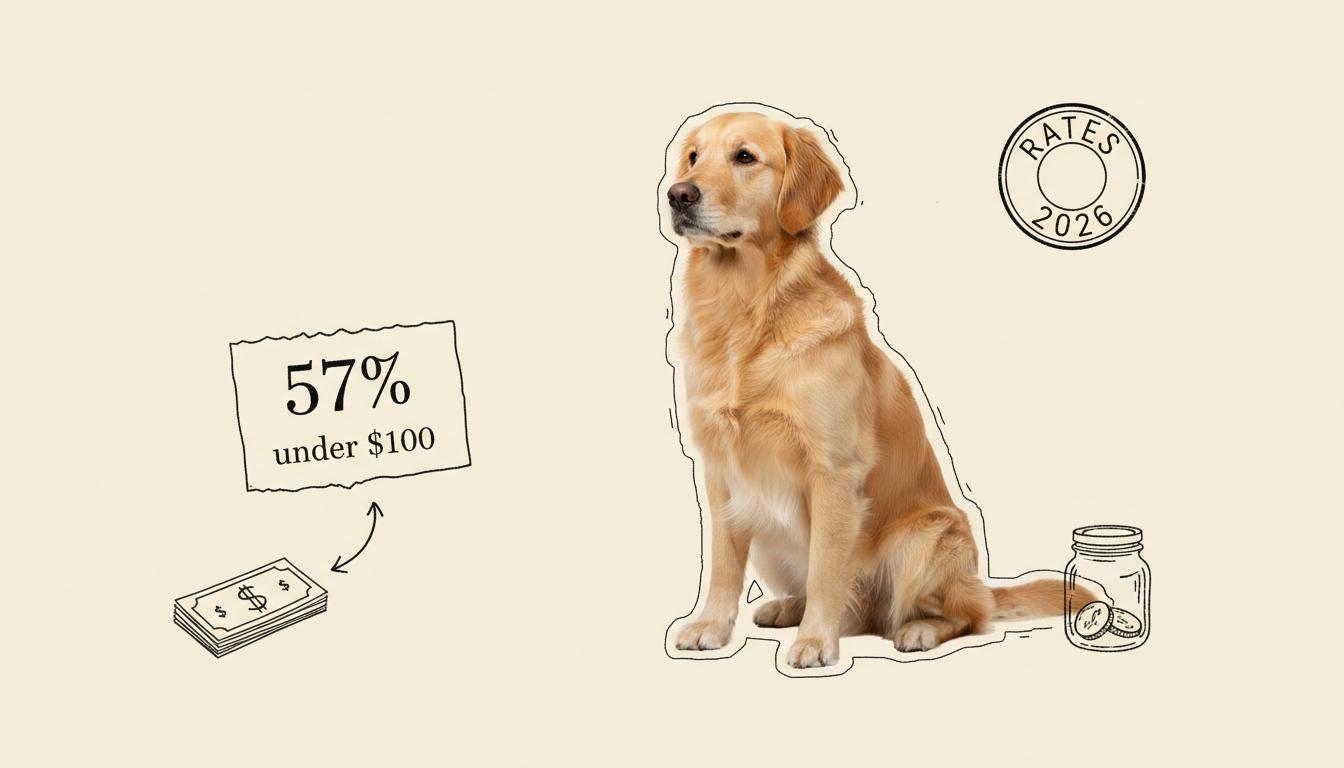
Most public rate cards measure what creators list, not what brands pay. The influence.co pets-category database (601 self-reported profiles) puts the average around $150 per post, with 57% of creators listing $100 or less. That's a useful industry reference — but it's an asking price, not a cleared one.
On Dogfluence we can see both sides of that number. Across 1,798 paid collaborations, creators list packages around $100 (median), but the fee that actually clears is lower: the typical agreed rate is $50–60 per collaboration. The gap between what creators advertise and what brands pay is the single most useful thing in this dataset.
Here is how those cleared rates distribute:
- About 33% of paid collaborations land under $50
- Roughly 60% are $100 or less
- Nearly 89% are under $500
- Only about 6% clear $1,000+
That distribution reflects the structure of the pet creator market: it is overwhelmingly nano and micro accounts who have built highly engaged niche audiences without professionalising their pricing. The $50–$200 range covers the majority of workable brand partnerships. Above $1,000 you are essentially in celebrity-pet territory — accounts like @jiffpom or @tunameltsmyheart, which function more like media properties than individual creators.
One caveat worth stating plainly: figures are nominal (predominantly USD, not currency-converted), and gifting-only deals — which involve no cash rate at all — sit outside this distribution entirely. As the next section shows, gifting is in fact the dominant way pet collaborations begin.
What does engagement look like for dog accounts?
Follower count drives rate conversations, but engagement rate predicts campaign outcomes. Across 9,000+ dog creator profiles and 180,000+ posts analysed on Dogfluence, the average engagement rate is about 3% — roughly 2× the 1–3% norm for human-influencer categories cited by benchmark studies including Rival IQ's 2025 Social Media Industry Benchmark Report.
But the average hides the real story, because engagement moves inversely to follower count. Sub-10k dog accounts often run 4–8%; micro accounts (10k–100k) settle around 1.5–2%; and accounts above 100k typically fall below 1%. The most engaged dog audiences are concentrated in the smallest, cheapest tier.
Follower count is a vanity metric here — engagement is the number that sets the price.
Pair that with the rate data and the efficiency is stark: a nano creator at ~$50 and 5–8% engagement reaches a far more responsive audience than a macro account costing 10–20× more at a fraction of the engagement. Raw follower-count pricing formulas, borrowed from human-influencer marketing, systematically undervalue dog creators at the nano and micro tiers. Brands that price only by reach leave money on the table.
Gifting vs paid: how pet collaborations are actually structured
Rate benchmarks tell only part of the story. Across 6,000+ completed collaborations on Dogfluence, gifting-first is the dominant entry structure: the brand provides free product, and the creator produces and posts content in exchange — no cash changes hands. This has historically been the primary way pet brands test new creator relationships before committing to paid sponsorships.
The gifting model suits the economics of both sides at the nano-to-micro tier. Brands get authentic, low-cost content from creators who genuinely use their products; creators receive product for dogs they would photograph anyway. The friction is low and the relationship can build toward paid partnerships over time.
That structure is shifting, though — slowly. More creators now publish explicit paid packages, and the share of collaborations that carry a fee is climbing. That shift shows up directly in the rate trend, which we look at below.
Rate table: what to expect by tier
The table below blends Dogfluence cleared rates (where our paid sample is robust) with public industry ranges (where it is still thin). Ranges represent typical rates rather than absolute minimums or maximums — individual accounts vary based on engagement, niche specificity, deliverable scope, and usage rights.
| Tier | Follower range | Typical per-post range | Source |
|---|---|---|---|
| Nano | 1,000–10,000 | ~$50 (gifting common) | Dogfluence cleared |
| Micro | 10,000–100,000 | ~$80 (listed $100–300) | Dogfluence cleared |
| Mid | 100,000–500,000 | $300–$800 | Industry range |
| Macro | 500,000+ | $800–$2,500+ | Industry range |
Nano and Micro figures are first-party cleared rates from Dogfluence; Mid and Macro use public industry ranges where our paid sample is still limited. Our (small) mid-tier sample trends toward the upper end of that range.
Brands benchmarking against this table should always cross-reference engagement rate. A nano account charging $50 with 15% engagement is priced differently than a nano account charging $50 with 1% engagement, even though both fall in the same tier by follower count. If you want to compare against live numbers, every creator's engagement and collaboration history is visible before you propose a deal.
Methodology
Rate data combines two sources. Industry reference figures (the ~$150 average and 57%-under-$100 listing distribution) come from the influence.co public pets-category database (601 self-reported profiles, accessed May 2026). First-party cleared and listed rates come from 1,798 paid collaborations recorded on Dogfluence through June 2026; amounts are stored in cents and reported here in nominal currency (predominantly USD, not currency-converted). "Listed" is the creator's published package price; "cleared" is the fee agreed on completed paid collaborations.
Engagement rate benchmarks are calculated from Dogfluence platform data: 9,000+ creator profiles across dog-content channels, covering 180,000+ published posts, as of June 2026. Engagement rate is (likes + comments) / followers × 100 at the post level, averaged across each creator's published post set, then aggregated across profiles. The platform-wide average is approximately 3%; the tiered figures (4–8% sub-10k, falling below 1% above 100k) describe the inverse relationship between audience size and engagement. Industry-norm comparisons (1–3%) reference the Rival IQ 2025 Social Media Industry Benchmark Report.
Collaboration structure data reflects 6,000+ completed collaborations recorded on the Dogfluence platform between launch and June 2026. A "completed collaboration" is a deliverable marked fulfilled by both the brand and creator. The gifting-vs-paid split is based on the compensation type recorded at deal creation, where the large majority are product-only (gifting).
Rate trend is measured as the median agreed fee on paid collaborations by year. This page is refreshed monthly; first-party figures are re-pulled from live Dogfluence data each time it updates.
Where rates are heading
The clearest signal in our own data is that the price floor is lifting. The typical agreed fee on a paid dog collaboration moved from roughly $58 in 2023 to $60 in 2024 to $100 in 2025 — about a 70% rise in the median over two years. (We exclude the current year, which is only a partial sample.)
The price floor is lifting as brands move from one-off gifting to paid, engagement-priced collaborations.
The structural driver is brands learning to price by engagement rather than reach. As post-level performance becomes easier to track, collaborations are increasingly priced on expected outcomes instead of estimated audience size — a shift that benefits high-engagement nano and micro dog accounts the most. For more on why the small-account tier punches above its weight, see our breakdown of micro vs macro pet influencers.
If you're a brand looking to benchmark your current rates against live Dogfluence campaign data, the platform shows you engagement rates and collaboration history for every creator before you propose a deal.
Find dog creators your customers already follow
Launch your first campaign in minutes — browse vetted dog creators, set deliverables, and only pay for real results.
Written by
Dogfluence Editorial
Editorial team
Guides and stories from the Dogfluence editorial team.